Thermoforming Mold Guide: Design, Materials, and High-Performance Tooling for Food Packaging
2025-12-12Thermoforming molds are the core tooling systems that determine the quality, speed, and cost of modern food packaging production. From cups and lids to clamshells and ready-meal trays, no thermoforming line can achieve consistent output without a well-engineered mold. As machines become faster and packaging standards become more demanding, the mold—not the machine—has become the biggest driver of cycle time, wall-thickness uniformity, and long-term production stability.
This guide provides a complete, engineering-focused explanation of thermoforming mold design, materials, cooling systems, venting, plug-assist technology, and real food-packaging applications—helping manufacturers understand how tooling decisions directly affect product quality and operational efficiency.
If you’re new to thermoforming and want a simplified introduction before diving into engineering-level mold design, see our thermoforming mold basics guide.
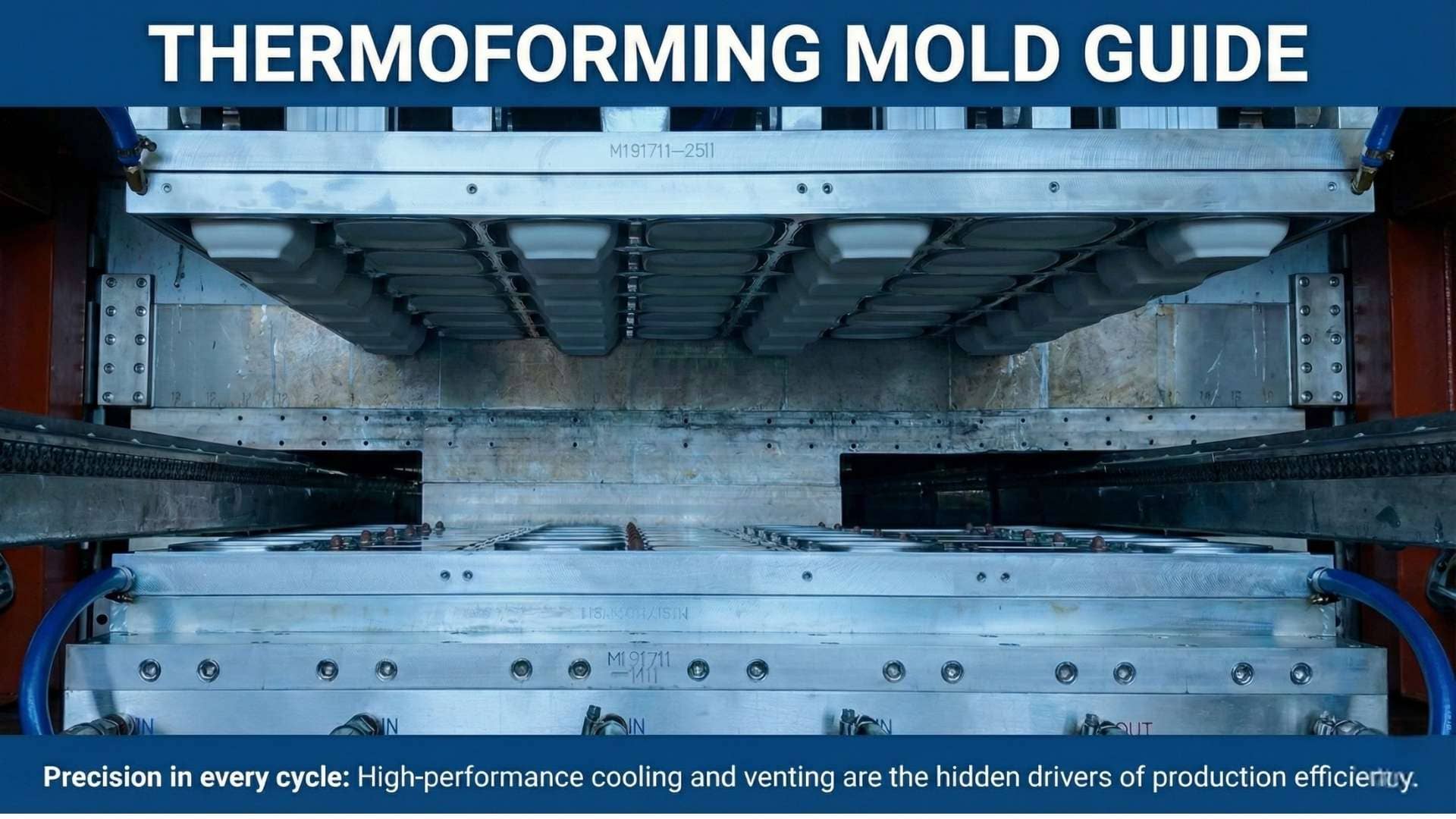
What Is a Thermoforming Mold? Understanding the Tooling System Behind Modern Packaging
A thermoforming mold may look like a block of metal from the outside, but it is actually a fully engineered system combining geometry control, thermal management, airflow engineering, cutting precision, and automated part handling. Its job is not only to form the shape—it must ensure repeatability at scale.
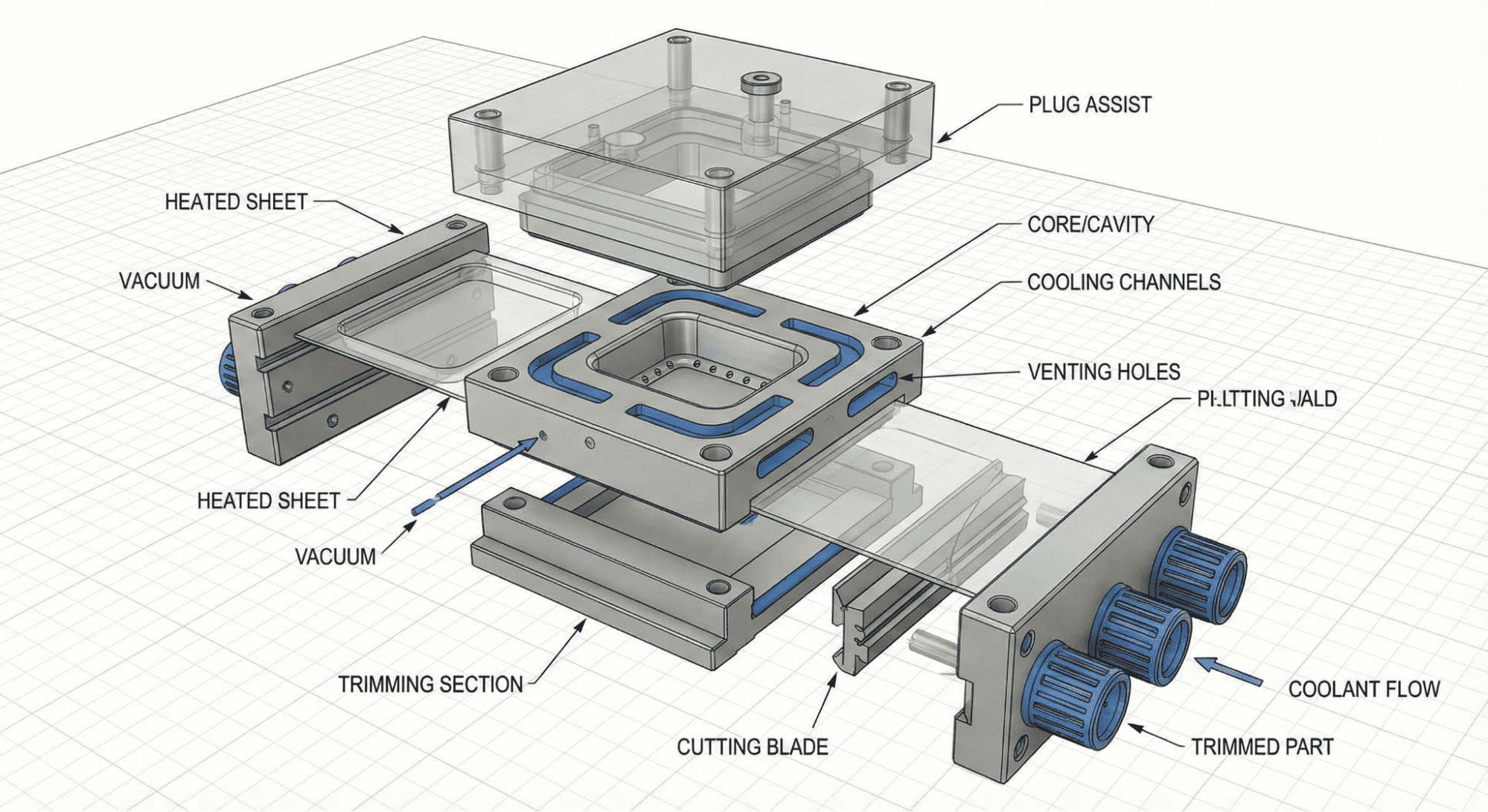
A complete mold set typically includes:
-
Forming Mold (Core & Cavity)
– Defines the final geometry and mechanical structure. -
Plug Assist
– Controls material distribution for deep draws. -
Cooling Channels
– Stabilize heated plastic rapidly for cycle-time optimization. -
Venting Systems
– Micro-vents allow air escape for crisp definition and sharper edges. -
Cutting Tools
– Steel rule dies, matched metal dies, or trim-in-place systems. -
Stacking/Ejection Components
– Enable automation and high-speed downstream handling.
A poorly engineered mold may produce acceptable parts at low speed, but a well-engineered mold optimizes wall uniformity, hinge durability, sealing flatness, stacking tolerance, and ultimately, your cost per cycle.
For a foundational overview of thermoforming processes, see:
→ Thermoforming Food Packaging: Everything You Need to Know
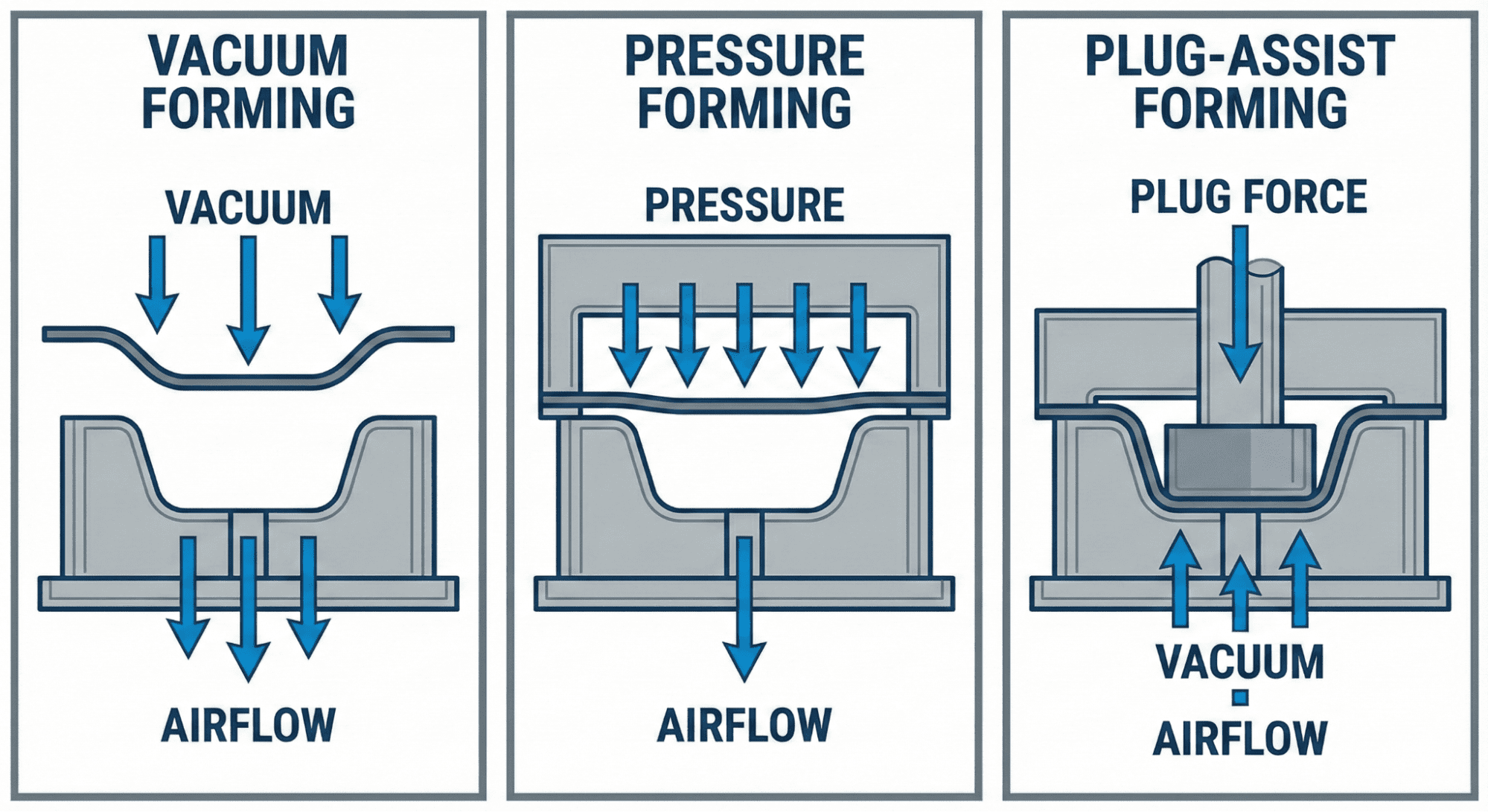
Thermoforming Forming Methods and Their Tooling Requirements
Each forming method behaves differently under heat and pressure. Selecting the right technology—and designing the mold around it—is essential for production efficiency and quality.
-
Vacuum Forming
Vacuum forming uses negative pressure to draw the heated sheet onto the mold.
Best for:
- Shallow trays
- Simple packaging geometries
- High-volume, cost-sensitive products
Advantages:
- Lower mold cost
- Faster lead times
- Less mechanical load on tooling
Learn more about basic clamshell structures here:
→ Clamshell Packaging Design: A Guide to Choosing the Right Thermoforming Mold -
Pressure Forming
Pressure forming adds positive pressure to push material tightly against the mold face.
Why choose it:
- Achieves higher detail (logos, textures, undercuts)
- Ideal for consumer-visible packaging
- Better definition and wall control
Tooling requirements:
- Higher-pressure mold construction
- Reinforced cavity surfaces
- Advanced vent distribution
-
Plug-Assist Thermoforming
Plug-assist thermoforming is essential for deep cups and containers where wall thinning becomes a risk.
Engineering considerations:
- Plug material (syntactic foam, aluminum, acetal)
- Plug temperature
- Radius and geometry
- Surface friction control
For cup-specific molds and examples, see:
→ How to Select Molds for Cup Thermoforming Machines
→ Plastic Cup Molding: Thermoforming vs Injection Molding
Core Principles of Thermoforming Mold Design
High-quality molds balance machining precision with a deep understanding of polymer behavior, heat transfer, and airflow. The following principles determine long-term productivity.
-
Mold Layout & Sheet Utilization: The First Cost Driver
Layout engineering determines how efficiently the sheet is used and how evenly the material heats across the web.
A good layout ensures:
- Higher cavity count without compromising heating balance
- Lower scrap rate
- Better sheet index stability
- Optimal spacing for cutting
Even a 3% improvement in sheet utilization can significantly reduce yearly material costs.
-
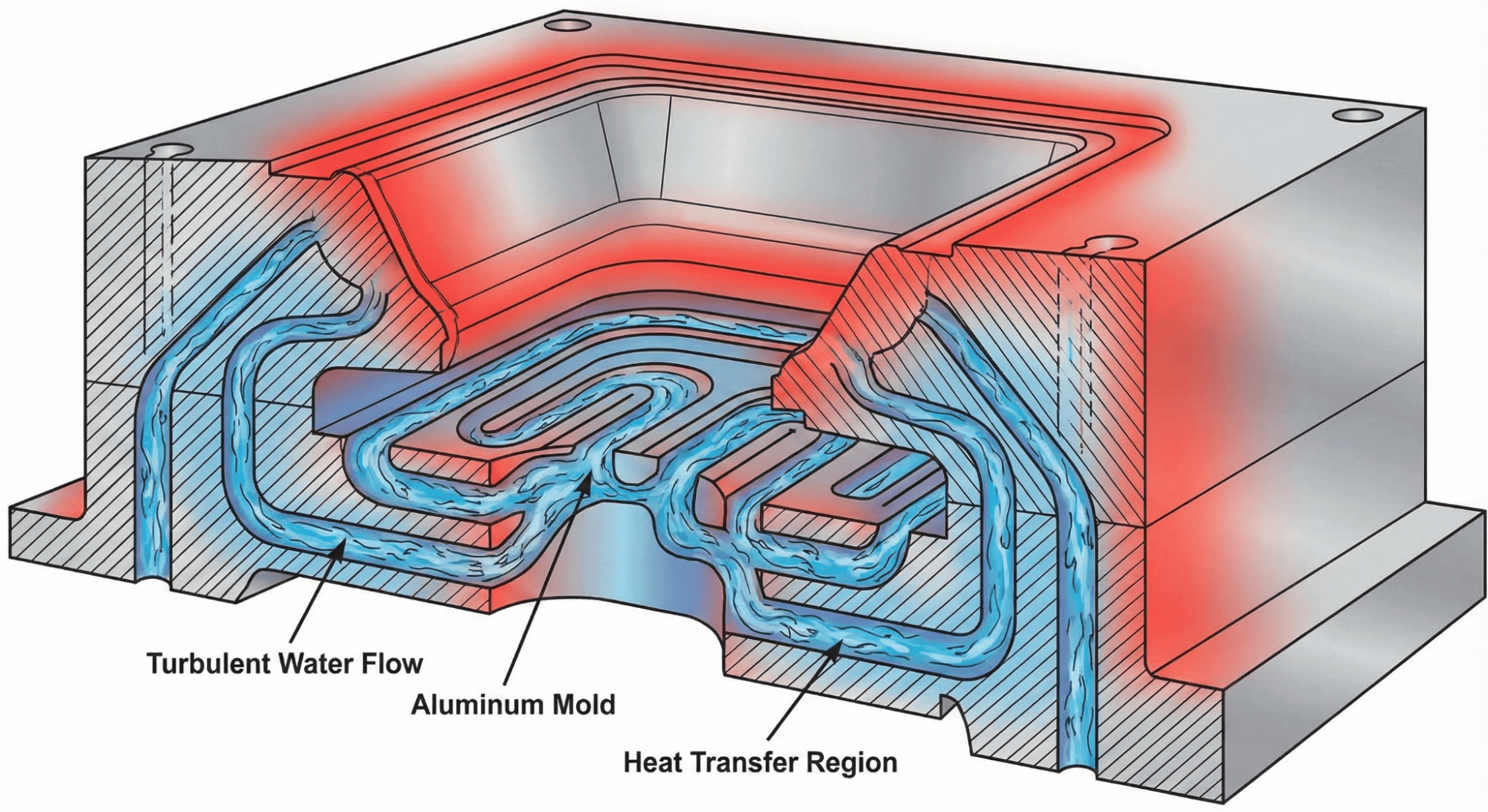
Cooling System Engineering: The True Cycle-Time Limit
Cooling—not forming—is the real bottleneck in thermoforming.The fastest production line is always the one with the most efficient cooling architecture.
Cooling engineering ensures:
- Flatness and warp control
- Consistent shrinkage
- Faster mold release
- Dimensional accuracy
High-conductivity aluminum alloys and turbulent-flow water channels are essential for high-speed lines.
-
Venting & Airflow: The Detail Maker
Air must escape instantly for material to contact the mold surface. Micro-venting provides:
- Sharper corner definition
- Better logo clarity
- Smoother surfaces
- Fewer burn marks
Placement is strategic—effective vents must not leave visible marks.
-
Plug Assist Engineering: Controlling Material Distribution
The plug directs material into deep areas before forming occurs. Its engineering determines:
- Bottom strength
- Corner uniformity
- Stacking repeatability
- Rim accuracy
Poor plug design leads to thin bottoms, weak corners, and weight inconsistencies.
-
Mold Material Selection: Speed vs. Durability
Different mold components require different materials:
- Aluminum – Best cooling speed, ideal for forming tools
- Tool Steel – Required for high-durability cutting edges
- Stainless Steel – Used for wash-down environments or heavy trimming
Matching materials to function increases mold life and reduces maintenance downtime.
Thermoforming Cutting Technologies: Steel Rule, Matched Metal, and Trim-in-Place
Cutting determines the final dimensional accuracy and sealing performance. Even perfectly formed parts can fail if trimming is inconsistent.
Steel Rule Die Cutting
- Cost-effective
- Good flexibility for frequent design changes
-
Common for clamshells and hinged containers
Learn more:
→ Choosing the Right Cutting Dies and Tools for Thermoforming Machines
Matched Metal Die Cutting
- High precision
- Ideal for PP and PET trays
- Long service life under heavy use
In-Mold Cutting (Trim-in-Place)
- Industry standard for cups
- Ensures identical rim geometry
- Eliminates trim variation for automated sealing systems
- Reduces manual handling
How Material Behavior Influences Thermoforming Mold Design
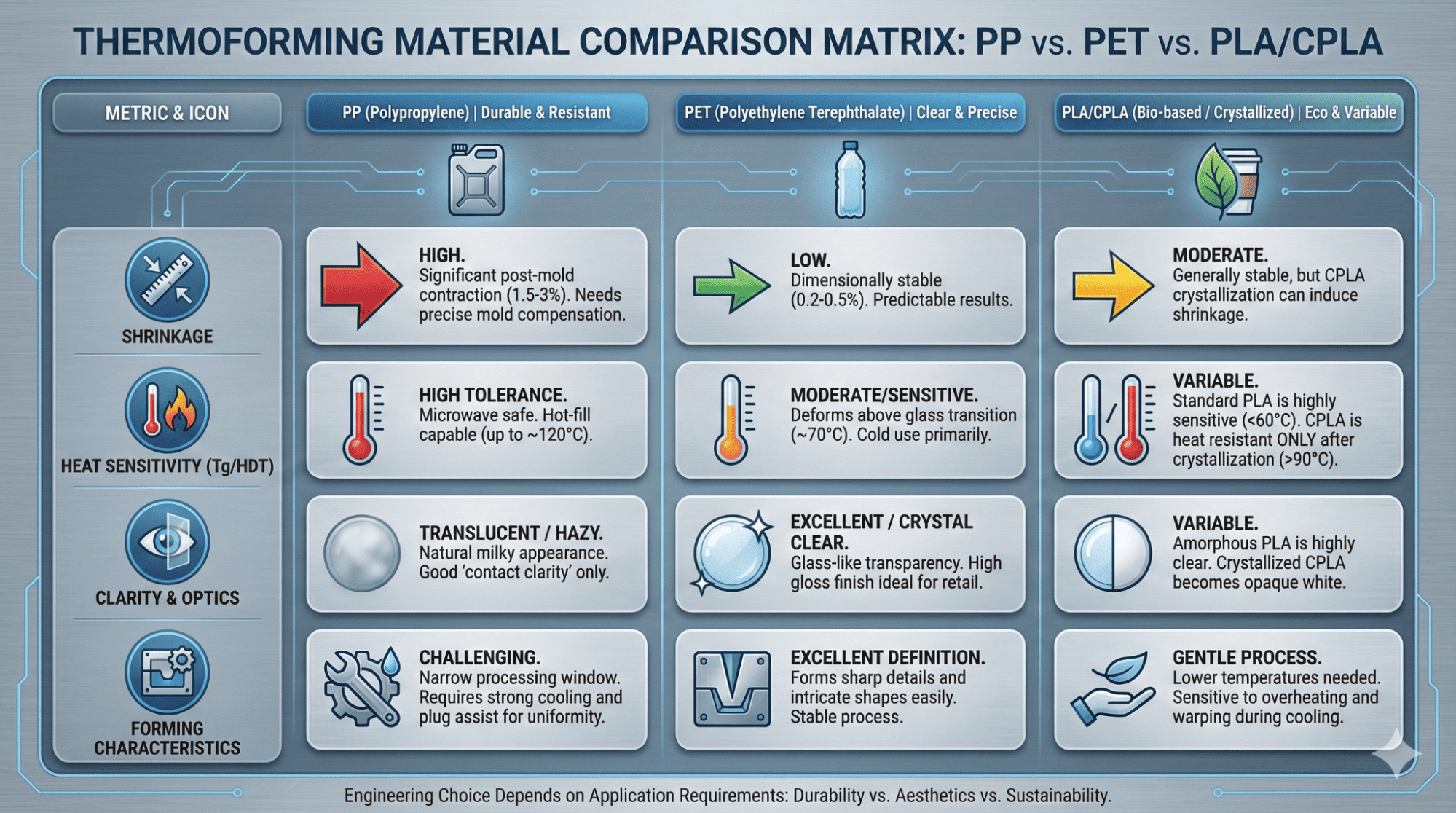
Each polymer responds differently to heat, pressure, and cooling. A mold optimized for PP will not work the same for PET or PLA.
Polypropylene (PP)
- High shrinkage → must be compensated in cavity design
- Excellent temperature resistance
- Ideal for ready-meal containers and lids
Polyethylene Terephthalate (PET)
- Requires polished molding surfaces
- Sensitive to temperature fluctuations
- Preferred for high-clarity packaging
PLA / CPLA
- Eco-friendly
- Narrow temperature window
- Requires careful cooling control
Polystyrene (PS)
- Easy to form
- Brittle—needs gentle venting and precise trimming
Thermoforming Mold Applications for Food Packaging
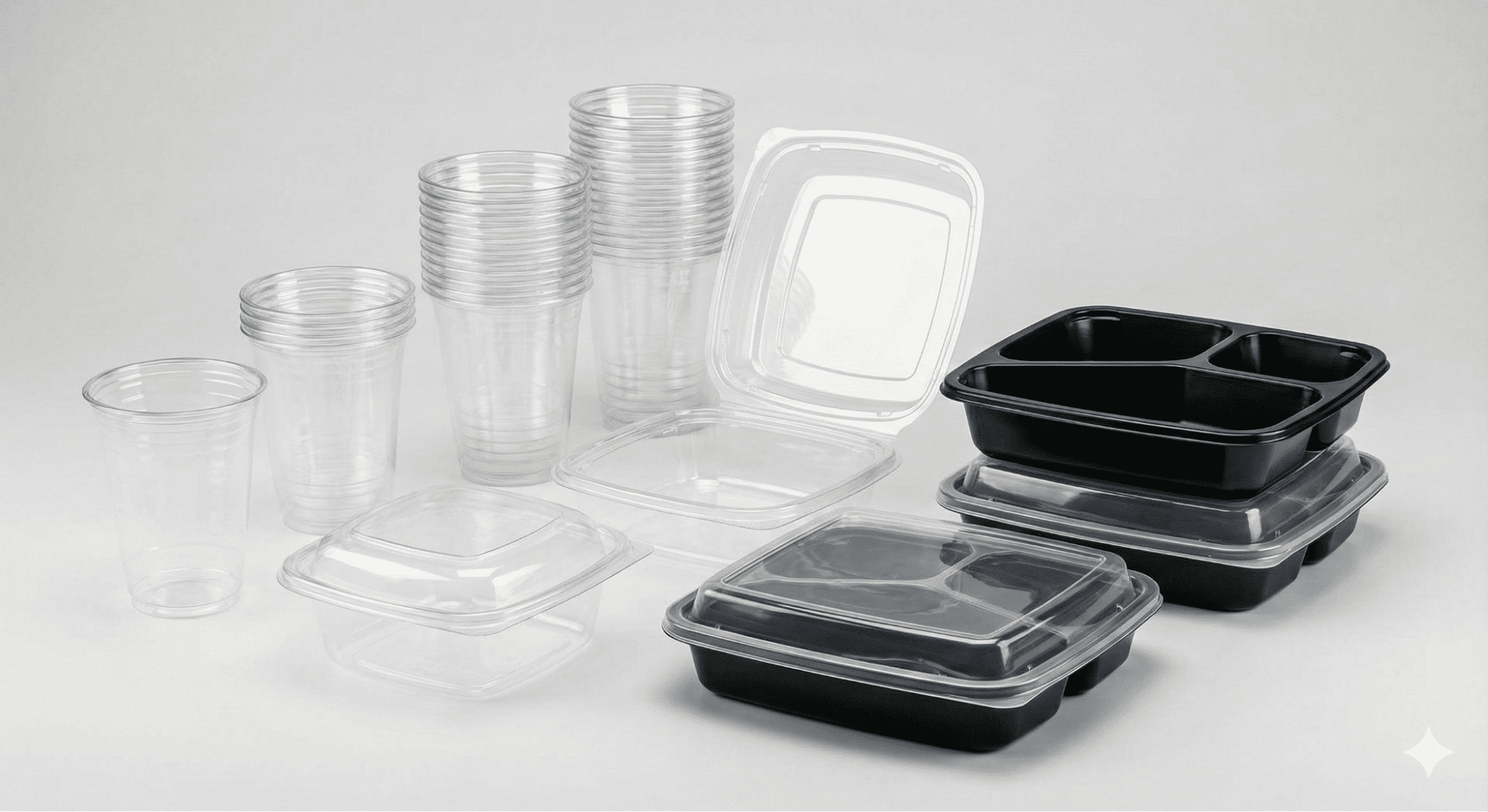
Each packaging category has unique engineering challenges. Molds must be designed with end-use functionality in mind.
Cups & Beverage Containers
- Rim accuracy determines sealing performance
- Uniform wall distribution increases stacking reliability
- Typically paired with in-mold cutting
Clamshells and Hinged Containers
- Hinge durability depends on vent accuracy
-
Snap-lock alignment must be engineered precisely
For detailed hinge and snap-lock designs, see:
→ Clamshell Packaging Design: A Guide to Choosing the Right Thermoforming Mold
Ready-Meal and Microwave Containers
- Flatness is crucial for sealing
- PP requires precise cooling to prevent warp
Fresh Produce Trays
- Optimized vent patterns for airflow
- Ribs must balance clarity and load-bearing strength
Quality Assurance & Mold Validation: Ensuring Reliability Before Mass Production
Hong Zu conducts a full validation workflow including:
-
Mold Trial Testing
- Heating profile verification
- Forming pressure tuning
- Plug temperature adjustment
- Cutting precision measurement
-
Dimensional Quality Checks
- Stack height variation tolerance
- Sealing flatness measurement
- Wall thickness mapping
- Optical clarity checks for PET/PLA
-
Reliability Testing
- Hinges opened/closed repeatedly for durability
- Snap-lock force consistency testing
- Stress testing of PP corners and deep areas
-
Machine Compatibility Validation
Molds are tested on systems such as:
ILLIG, WM, KIEFEL, GABLER, GN, CHUDONG, etc.
This ensures plug timing, forming pressure, and trim alignment match real production conditions.
Engineering Case Studies in Thermoforming Mold Design
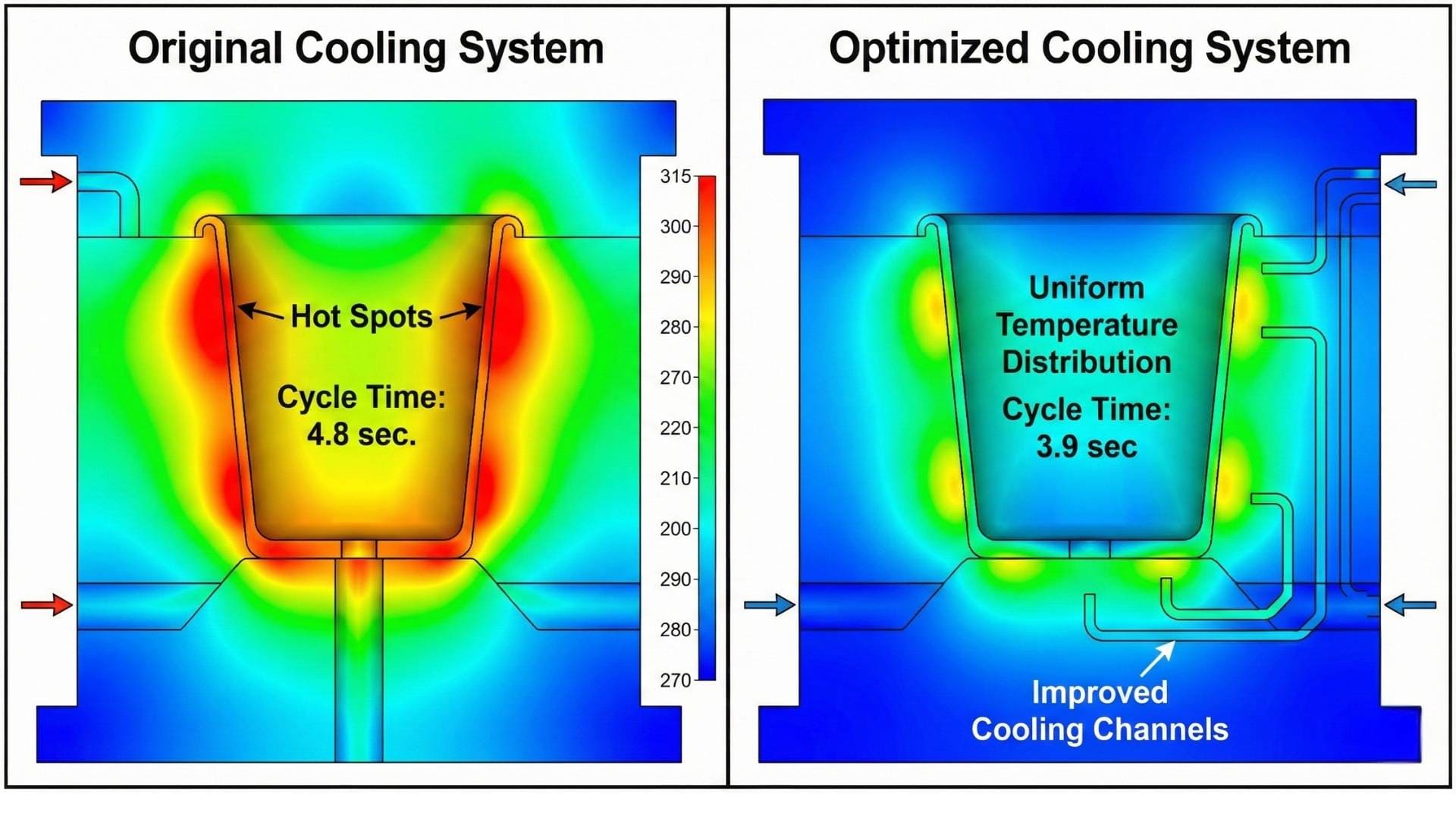
Case Example 1 — PP Cup Cycle Time Improvement (18%)
A customer producing PP beverage cups struggled with long cycle times (4.8 sec). After optimizing cooling channels and adjusting plug materials:
- Cycle time reduced to 3.9 sec
- Output increased by 18%
- Scrap reduced due to better bottom thickness distribution
Case Example 2 — Clamshell Hinge Failure Solved (40% Reduction)
A produce clamshell customer experienced hinge cracking during distribution.By re-engineering vent distribution and hinge geometry:
- Hinge failure rate reduced by 40%
- Closure consistency significantly improved
- Customer maintained the same sheet thickness (no material cost increase)
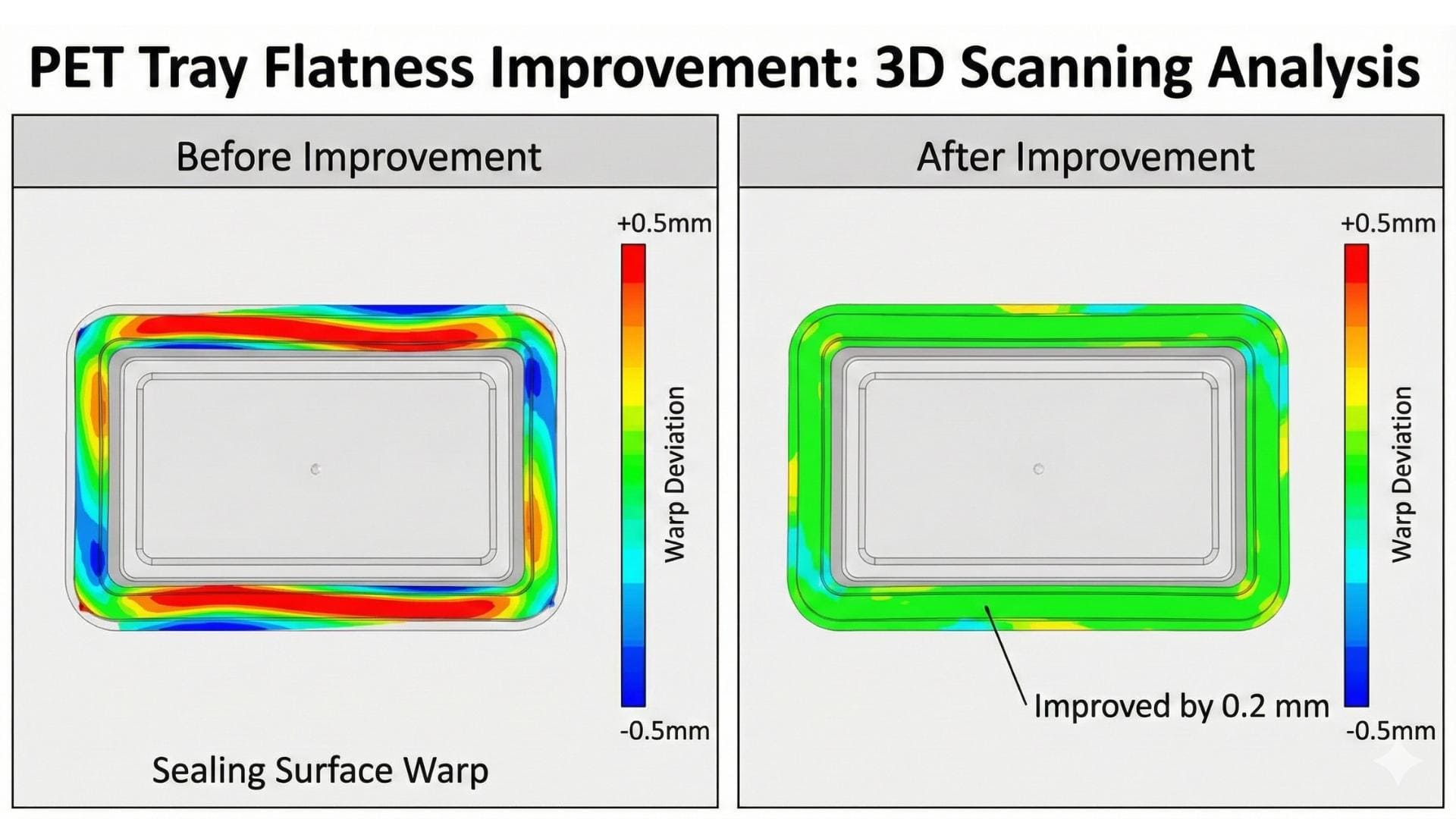
Case Example 3 — PET Tray Flatness Improvement
A ready-meal PET tray application suffered sealing issues due to warp.Hong Zu optimized cooling paths and cavity support:
- Seal flatness accuracy improved by 0.2 mm
- Production downtime reduced
- Product passed hot-fill sealing tests on first attempt
These real-world results validate mold engineering decisions with measurable performance outcomes.
Why Manufacturers Trust Hong Zu
With more than 35 years of dedicated thermoforming mold experience, Hong Zu has grown from a precision toolmaker into one of Asia’s most reputable engineering partners for food packaging manufacturers.
Our Advantages Include:
-
High-Speed Compatibility
Molds engineered for leading machines worldwide. -
Cycle Time Optimization
Cooling designs that remove seconds from every cycle. -
Advanced Engineering Tools
CAD/CAE simulation, airflow modeling, shrinkage compensation analysis. -
Full Lifecycle Support
From early product design to mass-production mold tuning. -
Proven Reliability
Thousands of molds delivered globally for cups, clamshells, trays, and more.
Hong Zu does more than build molds—we help customers solve forming issues, improve efficiency, and scale production with confidence.
Ready to Optimize Your Production?
If you are launching a new packaging product, solving a forming or trimming issue, or aiming to reduce your cycle time and scrap rate, our engineering team is ready to help.
Share your drawings, samples, or production goals, and let’s build a thermoforming mold that becomes your competitive advantage. Contact Us Today.